Following our recent exhibition, the VAD conference workshop 'Carrying the Message', and a dedicated session with students from the 'Introduction to African Studies' seminar at the BAB, the work with these unique objects continues behind the scenes: In this month's first blog post, our intern Siraiyion Kipury shares her personal insights on cataloguing and engaging with this extraordinary archive of everyday material culture.
***
Resting before me in the intern office of the BAB are hundreds of bags.
Rest: Freedom from activity or labour; Absence of motion
They lie together
Telling stories from Dakar
To others that only know of Kampala
Some were manufactured in Namibia, while others were handstitched in Ghana
One is completely covered in finely detailed print while another is totally transparent
Each one contains an entire world that reveals itself differently to whomever interacts with it. It almost sounds mystical.
How do I begin to select just one to share? When I know that whatever I choose will result in a completely different story being told?
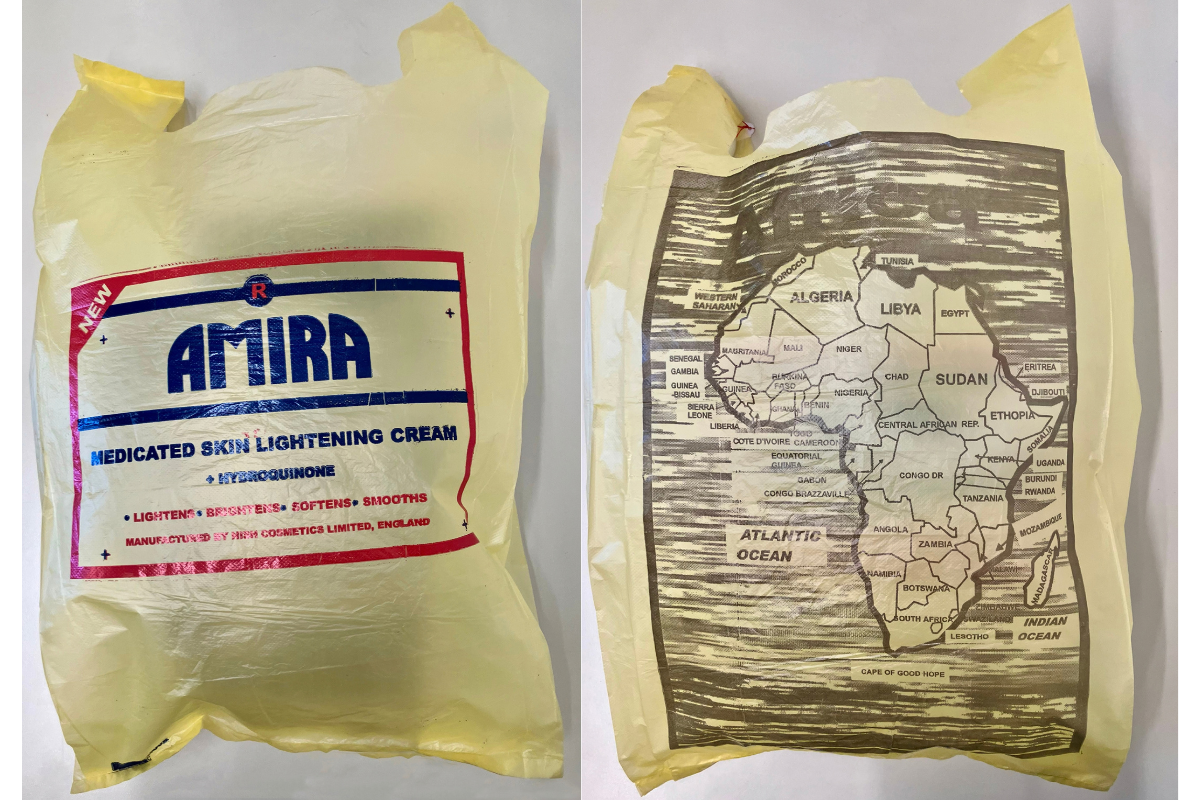
A bright yellow colour catches my eye. “Is that the map of Africa?”
The bag reads:
NEW
AMIRA
MEDICATED SKIN LIGHTENING CREAM + HYDROQUINONE
LIGHTENS · BRIGHTENS · SOFTENS · SMOOTHS
MANUFACTURED BY NISH COSMETICS LIMITED, ENGLAND
The other side of the bag carries a map of Africa with every country named. I notice that Sudan is still a single state, which leads me to guess that the bag must have been collected in the 2000s. I also think about recent initiatives supported by UNESCO to phase out the 16th century Mercator map because of its disproportionate representations that shrink Africa in particular. This means that in the future, one might also read this map through the lens of changing cartographic norms and representations.
I flip the bag again and now the words “SKIN LIGHTENING” meet me in a different way.
In 1999, The Observer investigated Nish Cosmetics which is a Manchester-based company that was at this time producing three of the most popular skin-lightening creams in Africa; Amira being one of them. The hydroquinone that is advertised on the bag is a chemical compound that affects skin pigmentation through two mechanisms. It damages specialised cells called melanocytes that are responsible for the production of melanin, and blocks tyrosinase, which is the enzyme inside these cells that actually creates melanin. Melanin is a biological pigment whose functions range from absorbing radiation from the sun to protecting essential nutrients in the bloodstream from light. A disruption to its functions comes at enormous risk to one’s health and existence. For this reason, the use of hydroquinone cosmetic products is outlawed in South Africa, Kenya, Ghana, Uganda, Rwanda and Côte d'Ivoire.
Here, on this bag, it is proudly advertised, pointing to a different place with a different relationship to skin lightening products.
It arrived at the BAB from Zambia after Dag Henrichsen visited Livingstone in 2005. He acquired this bag in a market where they were being circulated en masse. I wonder how this bag and others identical to it would be perceived by a salesperson or shop owner from Livingstone, rather than an intern from Nairobi living in Basel – it carries contexts that can never be known by me.
The surface of this bag draws our attention to the surface of the skin and tells us a certain appearance is to be desired and can be acquired through the product it advertises.
What might at first glance appear to be an ordinary plastic bag, turns out to be a violent relic of Africa’s past and present.
I think that what I find most intriguing about cataloguing and processing this bag collection is the ability of these objects to reveal and conceal information simultaneously. The bag discussed demonstrates this in two ways:
1. The words printed reveal the desires that come with skin lightening and openly highlight the presence of a powerful chemical that helps to achieve those desires. The African map that is printed suggests the continent is somehow implicated in this desire for lighter, brighter, softer and smoother skin.
2. What the bag conceals are the violent histories of colonialism, enslavement and white supremacy which established proximity to lightness and whiteness as the ideals that bring one closer to divinity, high social standing, marriageability and modernity.
Here at the BAB is a collection of bags at rest. Not in use and not in motion, but they remain talkative.
***


